Schwerwiegende Sicherheitslücken ermöglichen CodeausführungBorns IT- und Windows-Blog
Erneut wird vor gravierenden Sicherheitslücken im beliebten Windows-Editor Notepad++ gewarnt. Drei Schwachstellen sind geschlossen. Zwei dieser Schwachstellen ermöglichen die Ausführung beliebigen Codes auf dem Computer eines Opfers.
Über den folgenden Tweet habe ich Informationen zu den drei Schwachstellen CVE-2026-48770, CVE-2026-48778 und VE-2026-48800 gefunden.
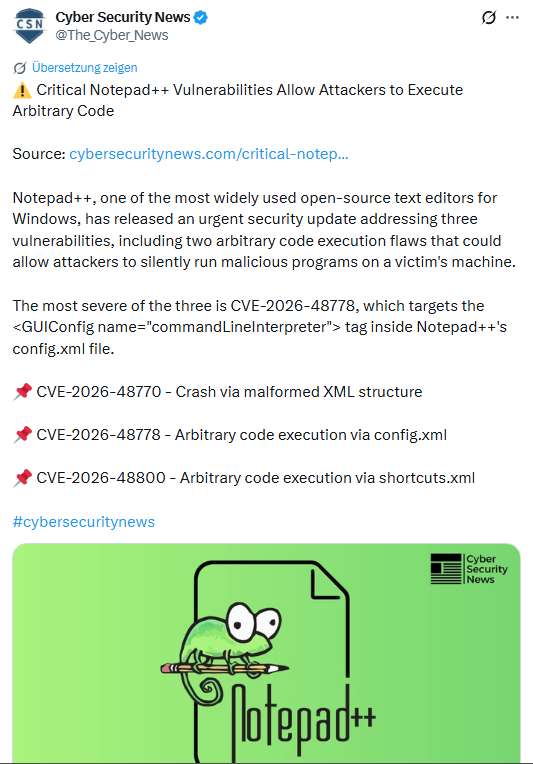
- CVE-2026-48770: Falsche Struktur führt zum Absturz der Anwendung.
- CVE-2026-48778: Sicherheitslücke ermöglicht die Ausführung willkürlichen Codes über config.xml-Dateien.
- CVE-2026-48800: Die Sicherheitslücke ermöglicht die Ausführung willkürlichen Codes Verknüpfungen.xmldie Dateien
Der Entwickler von Notepad++ hat am 26. Mai 2026 eine neue Version Notepad++ v8.9.6.1 veröffentlicht, in der die Schwachstellen behoben sind. Schwachstellen werden in diesem Bericht erwähnt.
Dieser Eintrag wurde unter Sicherheit, Software veröffentlicht und mit Sicherheit, Software getaggt. Link für immer ausführen.
Hinweis: Bitte er respektiert die Regeln für das Kommentieren im Blog (erste Kommentare und Links enden in der Moderation, ich veröffentliche sie alle paar Stunden, ich lösche SEO-Beiträge/SPAM strikt. Bitte kommentieren Sie in der Diskussion nicht zum Thema. Kommentare, die gegen die Regeln verstoßen, werden strikt gelöscht.
Gefällt mir der Blog, aber haben Sie Werbung blockiert? Sie können diesen Blog auch mit einer Spende unterstützen.
PakarPBN
A Private Blog Network (PBN) is a collection of websites that are controlled by a single individual or organization and used primarily to build backlinks to a “money site” in order to influence its ranking in search engines such as Google. The core idea behind a PBN is based on the importance of backlinks in Google’s ranking algorithm. Since Google views backlinks as signals of authority and trust, some website owners attempt to artificially create these signals through a controlled network of sites.
In a typical PBN setup, the owner acquires expired or aged domains that already have existing authority, backlinks, and history. These domains are rebuilt with new content and hosted separately, often using different IP addresses, hosting providers, themes, and ownership details to make them appear unrelated. Within the content published on these sites, links are strategically placed that point to the main website the owner wants to rank higher. By doing this, the owner attempts to pass link equity (also known as “link juice”) from the PBN sites to the target website.
The purpose of a PBN is to give the impression that the target website is naturally earning links from multiple independent sources. If done effectively, this can temporarily improve keyword rankings, increase organic visibility, and drive more traffic from search results.